
$82 at Erewhon...
"A year ago, I woulda bitched about how you spend too much money there now I find it kinda charming"

Song on Repeat:
“$82 at Erewhon” - Katelyn Tarver
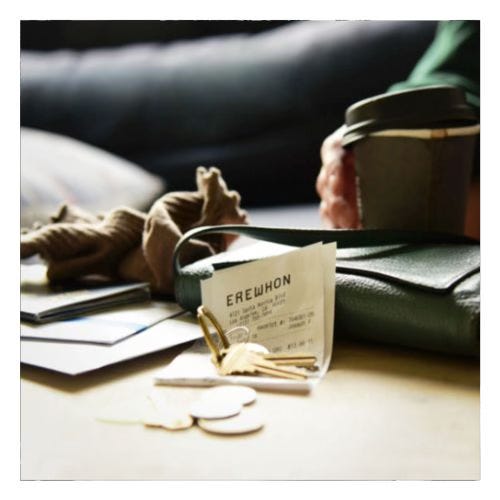
I was/am compiling a playlists of songs with poetic titles
Whether they be play on words, strong alliterations, universal truths, or just ones that catch the eye. Some of my favorites thus far include:
Family Is Family - Kacey Musgraves (& Shane McAlley, Josh Osbourne)
Money Isn’t Real - Jordan Davis (Jake Mitchell, Jameson Rodgers, Josh Thompson & Sarah Turner)
Sober & Skinny - Brittney Spencer (& Nelly Joy and Jason Reeves)
Jealous of Paris - Haley Joelle
I miss you, I’m sorry - Gracie Abrams (& Sarah Aarons)
Then, I woke up to a release from Katelyn Tarver titled “$82 at Erewhon”
Sure, it’s not the most poetic in terms of literary devices, but in its simplicity, LA relatability, and timely culture reference it is.
And of course, I listened to it instantly - assuming that’s the point of titles, especially ones that aren’t the hook. After all, the song shines in the verses and pre chorus, especially the first.
The Lyrics I Love:
Hit you up about a charge on the bank account we used to share
$82 up at Erewhon, a year ago, I woulda bitched about how you spend too much money there
Now I find it kinda charming, a little detail that I miss
Yeah, I know we had our issues but you were also my best friend
Wanna tell you ‘bout how I had to get a new car
How I miss when you’d laugh when a joke went too far
Wanna tell you about how I played a show out in France
How sometimes I wake up and still reach for your hand
My favorite part of this song on the surface is yes, the title. However, in general, the songwriting perfectly encapsulates the final stage of grief.
The first verse is perhaps the strongest, quickly setting the story of being annoyed at someone, but quickly making it a reason to miss them. It has strong contrast and is what makes the verse so nonchalantly devastating.
The pre-chorus goes on to quickly add depth and imagery - realizing that maybe you’re not missing them but the idea of sharing something - wether it be a bank account, car, sense of humor, or regular text exchange.
It’s simple in wording, but it’s also has a lot of profundity - something I have also come to appreciate with Katelyn’s most recent songwriting. After all, the pre chorus quickly going between missing sharing life little things, like a joke, with the bigger things, like waking up to them.
Like many rising artists, Katelyn has cowritten a lot - with most of her tracks on her last album being written between one or two other songwriters, especially ones who have experience cowriting with rising pop artists. Often, I found her writing similar to that of Sasha Sloan. However, this release sounded different - a bit more detailed, raw, and unedited.
And it was, as it was a 100 percenter.
And while I love songwriters (of course) and the refinement they can bring, this release seemed like it needed to just be one person - like a impromptu journal entry. At least for the verses and pre choruses.
The chorus, on the other hand, is undeniably underwhelming. But, perhaps that the point - encompassing what people see (or hear) on the surface, while also showing deep contrast.
Ooh, gotta keep it to the basics, fake it
Act like I ain’t been going through hell
Ooh, there’s so much I wanna tell you, so I just
Tell you that I hope you’re doing well
Yeah, I hope you’re doing well
And this is where I also come to appreciate the seemingly out of place but meaningful title of “$82 at Erwhon” instead of an obvious title like “hope you’re doing well.”
And while the second verse keeps the same stripped-down simplicity, the second pre-chorus pushes the story in classic Nashville songwriting fashion. It continues mixing mentions of the the mundane with the profound, but on a more personal level with topics like growing up, uncertainty, and the emotional yo-yo that comes with a breakup.
I wanna tell you ‘bout how I still don’t pick up my socks
How I’m scared all the time, but I’m growing a lot
How I still get confused about where we went wrong
How one day I’m okay, and the next one I’m not, but
And keeping with the narrative, the bridge wraps it up perfectly and a classic near rhyme. The simplicity works because it feels real - like that final line in a late-night journal entry when you just want to have some closure.
Wanna tell you ‘bout how despite the pain we both caused
In the end you’ll always be someone that I love, but
All in all, I think I love the title for yes, the cultural reference, but also the blatant juxtaposition.
It starts with a simple annoyance - an overpriced grocery-store transaction - that quickly ties it to something more personal: the irreplaceable memories of shared life. It’s a good summary to grief - no matter the type. You miss the little things - even the things you found annoying.